
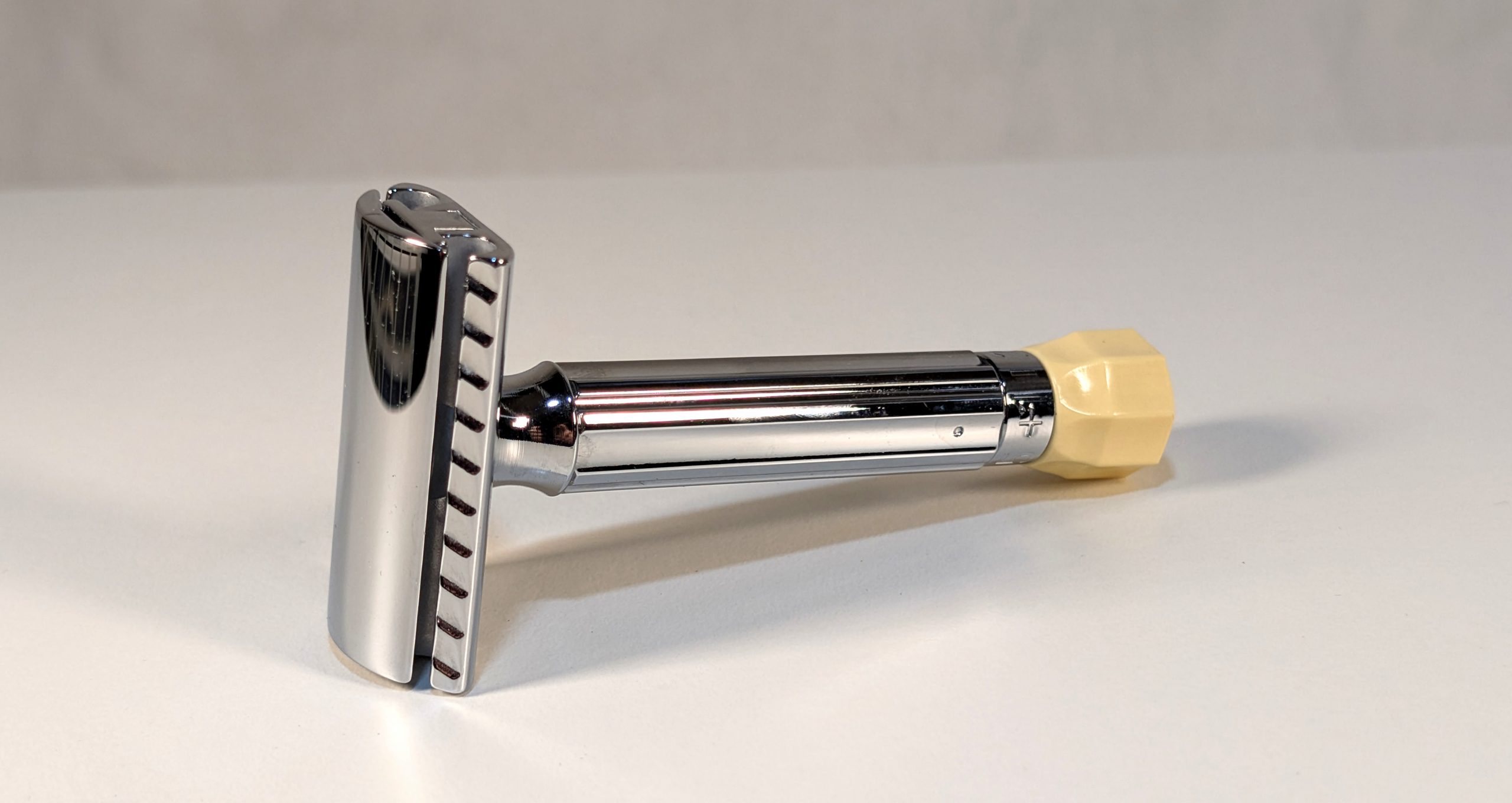
Adjustable razors have a special place in shaving. It takes some engineering to make a safety razor that can basically change the blade gap of the razor while not altering the rest of the razor. And I think this is why there are so many different designs for adjustable razors: 2 piece, 3 piece, butterfly (or twist-to-open), etc. Okay, yeah, non-adjustable razors have the same range of designs, so big deal.
Except that the engineering really is unique. So much so that Gillette didn’t produce their first successful adjustable until 1957, even though they didn’t truly invent the concept (there were designs going back to the 1920s, at least).
The Merkur brand is now about 125 years old, and is based in Solingen, Germany (as is, I should note, Haribo, of the Gummi bear fame). Merkur released the Progress 500 (or sometimes I see it called the 50c) somewhere around 1955, and it apparently has remained relatively unchanged ever since, with the plastic adjustment knob on the bottom being both loved and reviled at the same time, primarily for being plastic.
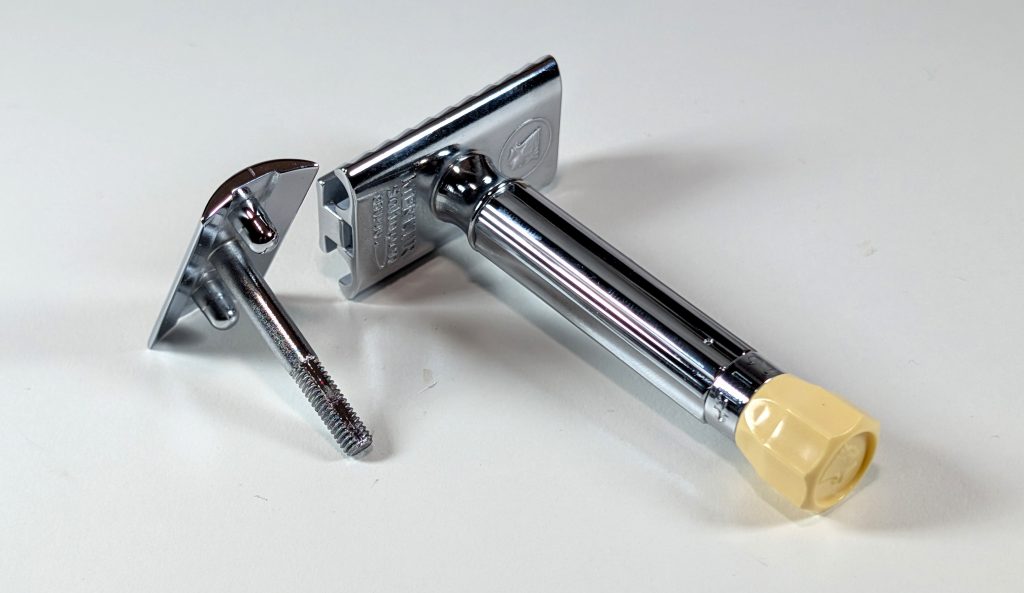
It’s unique in my collection for being a 2 piece design, as shown here. This means that the plate is physically attached to the handle, and the top cap adjusts via a long screw that connects somehow to the knob (okay, it clearly is attached to a tube or threaded receiver of some sort in the handle. I get it.)
The Merkur is also unique in my collection because the two other adjustables require changing the plate through flipping or swapping in a different plate. One advantage of this design over those is the ability to shave on a setting that is between the primary numbers, meaning that I could shave on 1 1/2 (or the dot between 1 and 2). Whereas the Rockwell 6c and Oliworks M3teorite have just 6 or 3 plates respectively.
So how do I fully review a razor that essentially has at least 9 settings? I planned on starting on the middle 3 primary settings: 2, 3 and 4, and see how those go. If I notice that it’s alarmingly mild or aggressive, I probably won’t fiddle with it in the first week, but I’ll do some experimentation in future shaves and report back in the weekly SOTD posts as needed. *You’ll note in a moment that my plan did need fiddling.
I’m excited to try my second German razor (the Mühle R89 was the first), and see how it compares to the other razors in the collection.
So let’s get to the review and see how it did in the first week of shaves.
The Progress has a nice weight to it, weighing 90 grams, which is the 4th heaviest razor in the collection, and while some reviews have said that the handle gets slick when wet, I didn’t experience any problems handling it–the fluting on the handle gives enough grip for me. The handle length is a little short, but I’m not sure I would have had that much more benefit from the long handled version (the Progress 510 or 51c).
The first time I went to load the blade, I immediately reached for the head to give it a twist, and…no. That isn’t how it’s done here, and that will take some getting used to. To replace the blade, you unscrew the twist knob on the bottom, and the top cap assembly will eventually free from the razor. From there, it’s pretty easy.
Another unusual thing I’ve noted is that there aren’t any holes or space on the bottom of the plate to assist in clearing the head of lather and hair. Instead, as you may be able to tell from the pictures, there are large channels inside of the curled base plate and comb, so rinsing the razor really needs to happen from the sides. Not a problem, but again, just a change of operations.
This is the first adjustable I own that is a twist adjustable (at least since 9th grade), and I can see it’s helpfulness in being able to adjust the razor during the shave. With my others, you have to swap base plates, which is less than ideal during the shave.
That being said, I found that, at least on setting 4 (and briefly on 4 1/2), the Progress was deceptively aggressive. There wasn’t the amount of blade feel or discomfort that I’d expect with a more aggressive setup, and I worked at making some extra passes on my neck in the first shave to get the closeness I want, which resulted in a lot more irritation than I wanted. But as you’d surmise from this statement, there wasn’t the efficiency I’d expect from a more aggressive shave.
With that lesson learned, the second shave was substantially better. I dialed it back to 2, and this felt much better. The razor glides very nicely, and really responds to a nice slick lather. I got an impressive shave with almost no irritation.
Dialing it back one more step to 1 on the third shave, I found that it was even more comfortable, with minimal blade feel, but a surprising efficiency. I did need some extra strokes, though, and those only contributed to just a couple of spots of irritation with the alum, but quickly went away.
So overall, what do I think? I can see why this design has lasted so long and is so widely used. It works well, is easily adjustable, and really a great razor. I need some more time with it, obviously, and I’ll most likely keep it set under 3, but I do need to recall that 4 wasn’t bad–I just couldn’t tell that it was being as aggressive as it is.
I’m anxious to pair it with a few of the other favorite blades and see how it does with the Perma-Sharp, Shark, Bic, 7 O’Clocks, and others. Those will come in time, but for now, I’m pretty impressed with the German additions to my razor collection.