
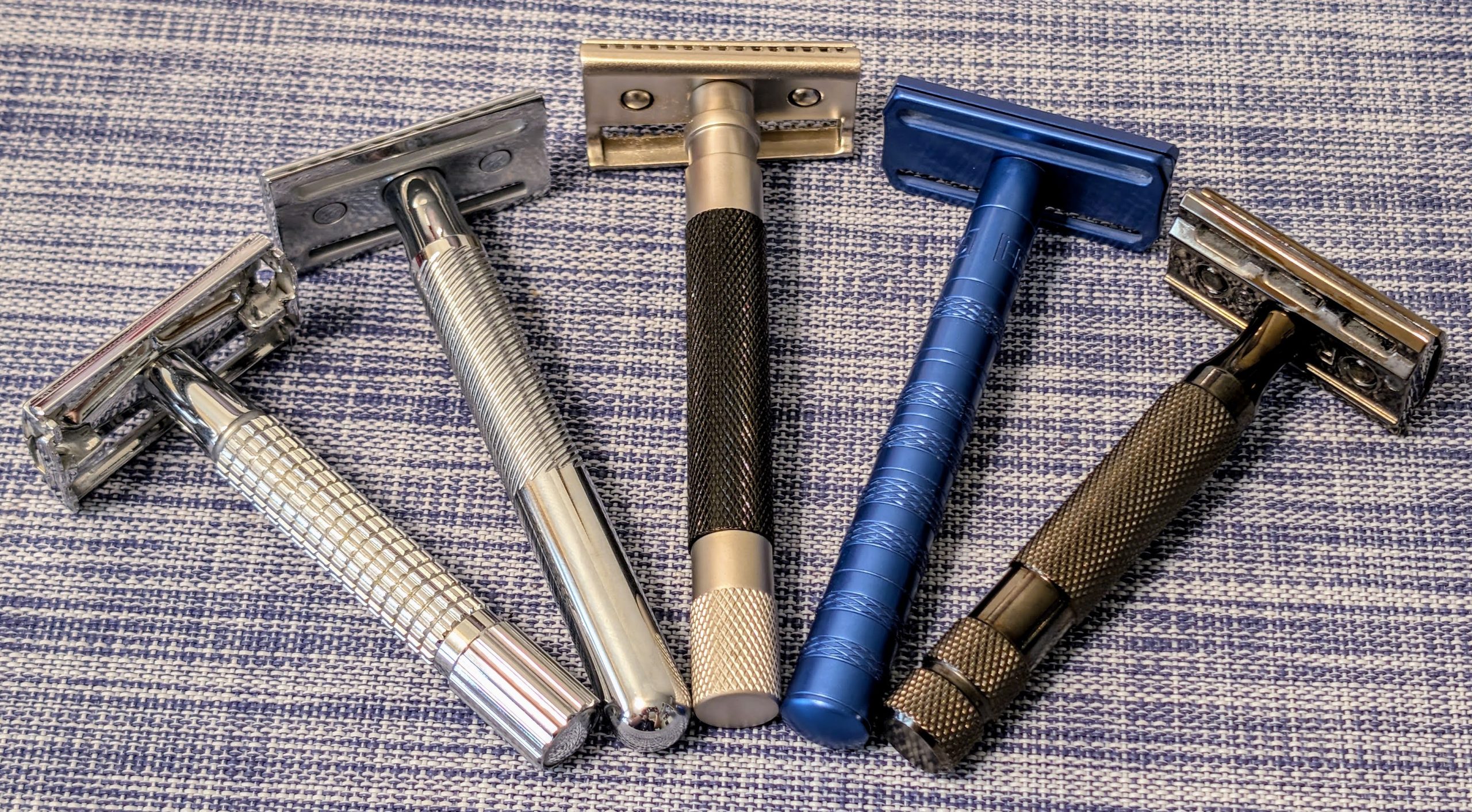
I (and my shaving enthusiast brethren) talk a lot about mild, medium, and aggressive razors, or as some prefer: efficient and less efficient. While this is a somewhat subjective measure, it does have some basis in a quantifiable science: blade gap.
Blade gap is the space between the blade and the blade guard/safety bar/comb. The larger that gap is, the more blade exposure there is to allow the blade to contact skin. And more blade contact with skin means either more efficiency and aggressiveness, or more irritation, depending on how your skin reacts.
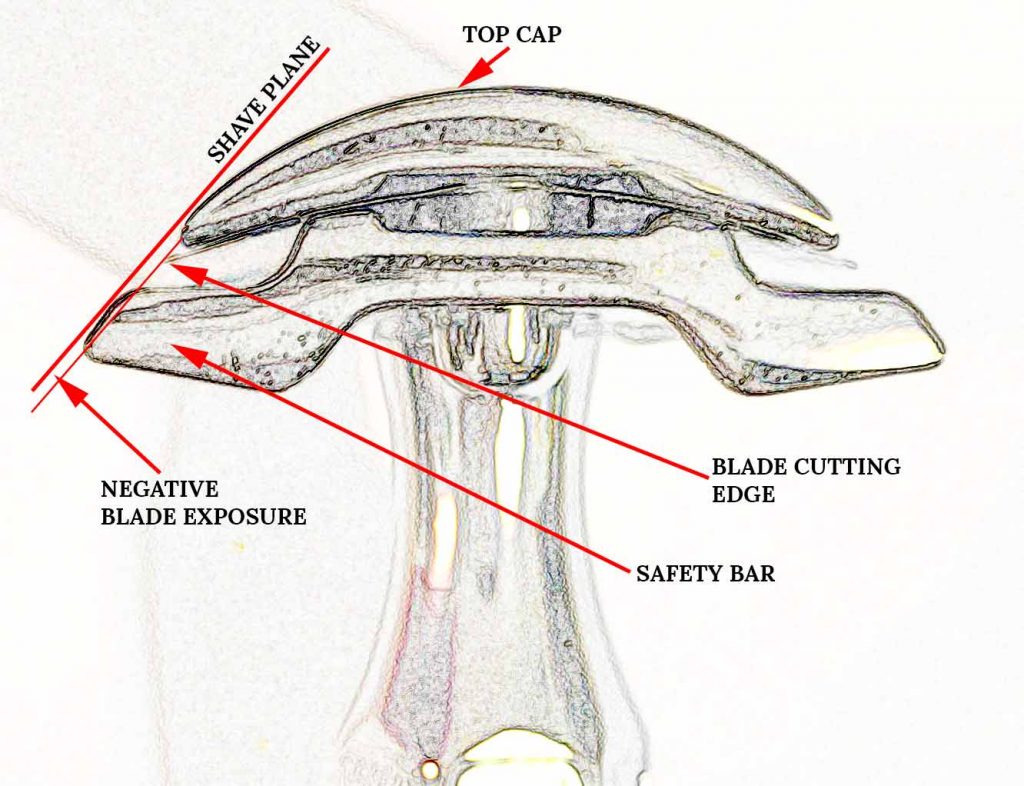
Let’s introduce some definitions on the safety razor head before we get too far into things here (and credit given to The Razor Company for the image at right): the top cap (or cap) is the top of a safety razor. Some twist-to-open (or butterfly) to reveal the blade. Others, like those on a two or three-piece razor are solid.
The plate is the bottom piece, and usually contains the safety bar or comb. Some designs have an open comb, which is basically what you’d expect–a toothy method of guiding the hairs into the blade, and others have a closed comb, or solid bar that really just holds the skin flat and tight between the cap and the safety bar and gives the blade a plane to shave against.
You’ll notice that the blade is curved. In all safety razors, the blade gets curved so that its cutting edge is at an angle to the skin passing it. According to Henson Shaving, that angle should be 30 degrees for optimal cutting. But you can see in the diagram above that the blade has some space in there. That’s the blade gap. Again, the larger that space is, the more contact the blade has with the skin.
Mild razors have a small blade gap, basically holding the blade very precisely in a small space and not allowing it to move much. But that also helps minimize blade exposure (which is the other part of the secret sauce of aggressiveness or efficiency of a razor). Blade exposure is exactly that: how much of the blade is exposed to the skin and hairs passing by. And it’s also how far away from the shave plane it is (as shown above). And let’s complicate this further by pointing out that safety razor blades are not all exactly the same size–they can be wider or narrower by fractions of a millimeter compared to others.
Oof. Confused?
I believe that if you want a comfortable shave and have sensitive skin like me, you want a mild razor. This will minimize blade contact (or blade feel) on your skin and lessen irritation. And for someone who can only get the closeness I want on my neck by shaving against the grain, mildness is important.
| Razor | Blade Gap | Blade Exposure |
| Rockwell 6C plate 1 | 0.20 mm | |
| Rockwell 6C plate 2 | 0.35 mm | |
| Rockwell 6C plate 3 | 0.48 mm | |
| Oliworks M3teorite mild plate | 0.51 mm | 0.069 mm |
| Rockwell 6C plate 4 | 0.61 mm | |
| Henson AL-13+ mild | 0.68 mm | 0.033 mm |
| Rockwell 6C plate 5 | 0.69 mm | |
| King C Gillette | 0.76 mm | |
| Oliworks M3teorite medium plate | 0.76 mm | 0.137 mm |
| Rockwell 6C plate 6 | 0.79 mm | |
| Henson AL-13++ medium | 0.85 mm | 0.058 mm |
| Oliworks M3teorite aggressive | 1.02 mm | 0.206 mm |
| Parker 55SL Semi-Slant | ??? | |
| Van Der Hagen | 0.56 or 0.71 mm |
So let’s talk measurements. I’ve gathered the blade gap measurements for all of the razors in my collection, and placed them in the table at left.
There are a bunch of things interesting to note here: first, that very few manufacturers seem to give a blade exposure measurement. I’m guessing that’s because the blade used will change that number. So I’m not sure how accurate or effective the measurement is for the Hensons and Oliworks.
Second, note that the VDH doesn’t list a blade gap in its specifications, and that after a pretty wide search online, I’ve found two widely accepted measurements, which don’t help much.
And apparently it’s hard to measure the blade gap for a semi-slant, so it typically isn’t given. At all.
These numbers bear out some of my real-world findings. First, the Rockwell plate 1 is almost useless to me because it’s so mild. But I really like plates 2 and 3, which are the next two lowest blade gaps here. And I compare the mildness of the shave from my Henson mild to plate 2 on the Rockwell. So could that be because the blade exposure comes into play?
At the same time, Rockwell’s plate 4 has a smaller blade gap than the Henson mild, and substantially lower than the Henson medium, and yet, I compare the Henson medium to plate 4, with plate 5 being more aggressive feeling than the medium and comparing to the King C Gillette.
So what does it all mean? Yes, there’s science here. Yes, these are actual measurements (at least in the blade gap, exposure seems to be a different thing). But they really become just one more tool to help measure effectiveness and comfort of a shave with a razor. Ultimately, that’s a subjective measure that really isn’t reliant on any single number.
I do need to try the Rockwell plate 6, especially since I’ve committed to trying the Oliworks aggressive. We’ll see how that one goes and maybe I’ll never try plate 6.